Hydrogen Rollout: Rhine-Ruhr Calls for Investment Certainty for Industry in Berlin
All press releases
“Our region has the industrial demand, the logistics hubs, and, above all, the expertise. Now it’s a matter of bringing together demand, infrastructure, and investment certainty.”
The recovery will depend on key industrial customers. The steel and chemical industries in the Rhine and Ruhr regions are driving the demand that supports production, pipelines, and import infrastructure.
The Hy.Region.Rhein.Ruhr network lists four conditions: competitive energy prices, faster procedures, safeguards for infrastructure investments, and planning certainty.
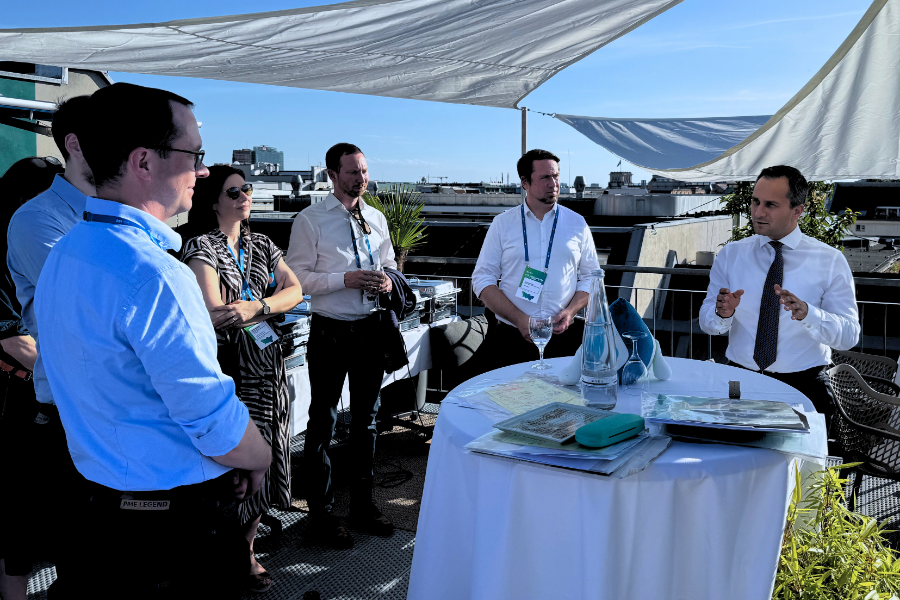
Political, business, and academic leaders gathered in Berlin to discuss the next steps.
Duisburg/Berlin, June 25, 2026. The hydrogen network Hy.Region.Rhein.Ruhr, together with Mahmut Özdemir, Member of the German Bundestag, hosted a parliamentary evening at the Albrechtshof’s Skybar in Berlin. Over a summer barbecue, representatives from business, politics, academia, and various institutions discussed how to turn the political goal of hydrogen into a viable market and what role the Rhine-Ruhr region plays in this process. The association’s office is located at Duisburg Business & Innovation (DBI), the city’s economic development agency.
The key lies with industrial anchor customers. Industries such as steel and chemicals consume hydrogen on a scale that makes investments in production, pipelines, storage, and import terminals economically viable in the first place. It is precisely these customers that are located along the Rhine and Ruhr. This is particularly evident in Duisburg: on the thyssenkrupp Steel plant grounds, the direct reduction plant is emerging as one of the world’s largest industrial decarbonization projects. With a project volume of more than two billion euros, it has the potential to avoid up to 3.5 million metric tons of CO₂ annually.
The network identifies four conditions necessary for a successful ramp-up: competitive energy prices, faster planning and permitting processes, mechanisms to safeguard infrastructure and storage investments, and planning certainty for companies that are currently deciding on investments worth billions. Without this certainty, business models for industrial users will remain unfinanceable.
The keynote address was delivered by Ralph Sina, a longtime WDR correspondent in Brussels and Washington. In his presentation titled “Energy as a Location Factor: Why Hydrogen Is Now Becoming Crucial After All,” he analyzed the energy, industrial, and geopolitical dimensions of the industry’s growth.
Mahmut Özdemir, Member of the Bundestag: “With its steel, port, energy, and logistics sectors, the Rhine-Ruhr region serves as a model for transformation. To accelerate the practical application of hydrogen, companies need reliable framework conditions, an efficient infrastructure, and faster procedures. The parliamentary evening offers an opportunity to learn from real-world experiences and discuss the next steps in policy-making.”
DBI Managing Director Rasmus C. Beck emphasizes the regional perspective: “The Rhine and Ruhr regions will determine whether hydrogen evolves from a promise for the future into an industrial location factor. Our region has the industrial demand, the logistics hubs, and, above all, the expertise. Now it’s a matter of bringing together demand, infrastructure, and investment certainty. The ramp-up of hydrogen requires industrial anchor customers, regional procurement alliances, and framework conditions that enable investment.”
Michaela Schröder, treasurer of Hy.Region.Rhein.Ruhr and managing director of GMVA Gemeinschafts-Müll-Verbrennungsanlage Niederrhein GmbH, offers her own perspective: “Hydrogen is an important building block of the transformation, but it is not the sole solution. Especially now, we need to think more holistically about technologies, industries, and sectors. It is crucial that we act pragmatically and implement solutions that reduce CO₂, strengthen security of supply, and are economically viable.”
High above the capital’s rooftops, the evening provided an opportunity for direct dialogue among decision-makers from the federal government, regional authorities, and the business community. The goal was to bring the practical experiences of the Rhine-Ruhr region into the political debate and to formulate specific requirements for the region’s continued growth.
For more information: