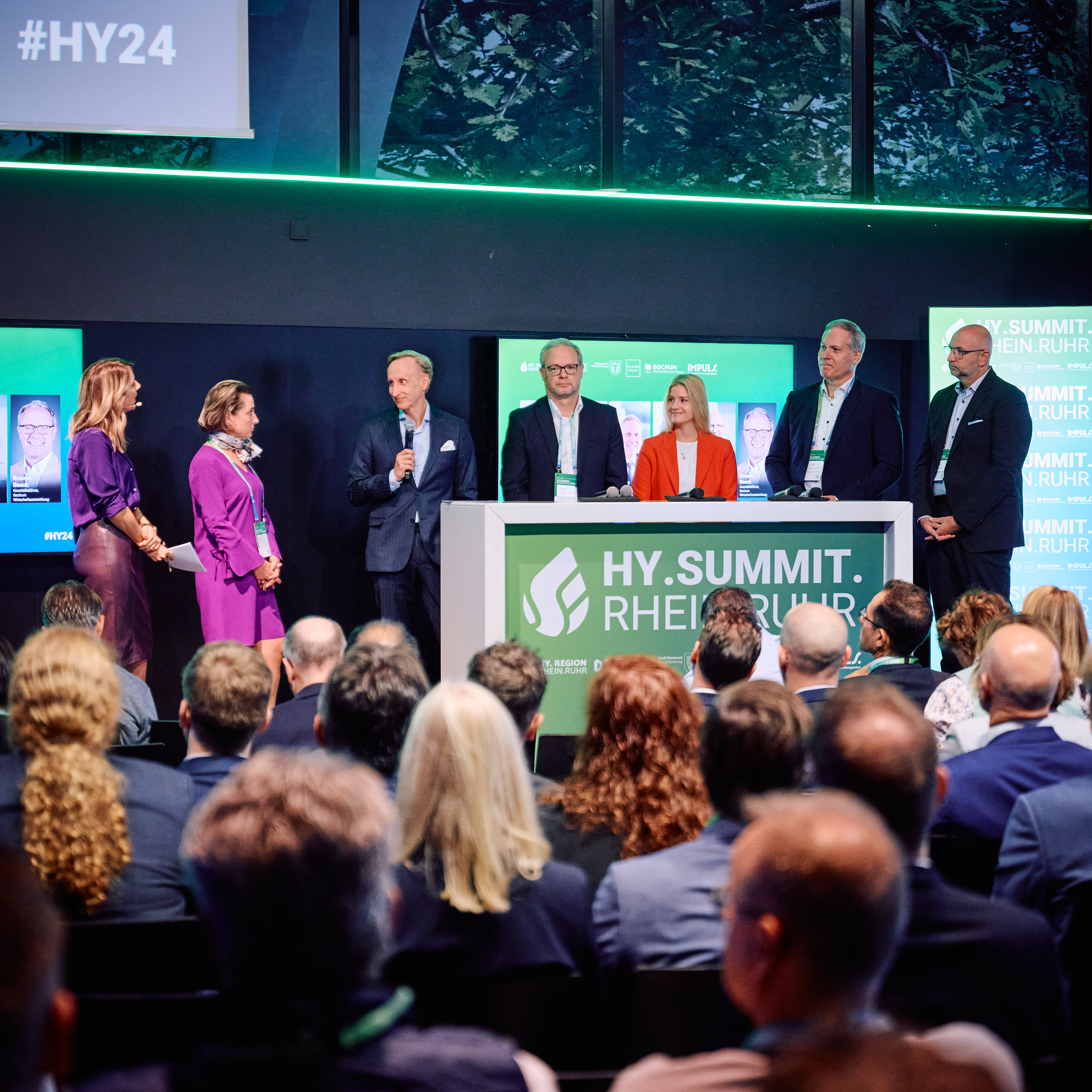
The sold-out Hy.Summit.Rhein.Ruhr 2024 brings together the leading minds in transformation over three days
All press releases
Vice Chancellor Robert Habeck: “The will to act is the motto of our time.”
Sold Out: Over 600 Guests in Duisburg, Dortmund, and Essen
Positive Response: Broad Support for the Hydrogen Rollout and Duisburg as a Steel Hub
Duisburg, Dortmund, Essen, September 18, 2024. The decarbonization of industry is entering a crucial phase. The course is now being set to determine whether the Rhine-Ruhr region can live up to its claim of being Europe’s hydrogen capital. The prerequisites are in place, with a dense network of industry and science as well as a broad commitment from the participating municipalities. But what is the state of the political framework?
Answers were provided at the Hy.Summit.Rhein.Ruhr 2024. The sold-out hydrogen conference brought together the leading minds driving this transformation over three days—at the opening gala in Duisburg, the business forum in Dortmund, and the science forum in Essen. More than 600 guests attested to the high level of interest in developments related to industrial decarbonization.
The regional hydrogen event was sponsored by the economic development agencies of Duisburg, Dortmund, Essen, Bochum, and Hamm, as well as numerous corporate sponsors, and was organized by the Hy.Region.Rhein.Ruhr association.
Comments on the Hy.Summit.Rhein.Ruhr 2024:
In his opening remarks, he emphasized Hendrik Wüst, Minister-President of the State of North Rhine-Westphalia, a clear goal: “We want to become the number one hydrogen region. We are a strong hub for industry and science—that’s what the Rhine-Ruhr region stands for. Together, we have every opportunity to make North Rhine-Westphalia the most modern and climate-friendly industrial hub in Europe. We will seize this opportunity.”
Dr. Robert Habeck, Vice Chancellor and Federal Minister for Economic Affairs and Climate Action: “The Rhine-Ruhr region is something special—an established industrial area that must transform itself. It must invest in new technologies. The fact that this determination exists at the heart of Germany as an industrial hub is not something to be taken for granted and is truly worthy of the highest praise. Because the region is not only important for Germany’s economy but also holds great symbolic significance. ‘Will’ is the motto of the day here.”
“Steel produced in Duisburg makes us more resilient in times of crisis,” said a Summit speaker Mona Neubaur, Minister of Economic Affairs, Industry, Climate Protection, and Energy for the State of North Rhine-Westphalia and Deputy Minister-President, as had already been emphasized at the Steel Summit in Duisburg.
Sören Link, Mayor of Duisburg: “Our shared goal is to establish the Rhine-Ruhr region as a leading force in the green transition toward a sustainable and climate-friendly economy—and the Hy-Summit has been the ideal forum for this.”
Thomas Westphal, Mayor of Dortmund: “Dortmund is a key supplier and technological hub for the hydrogen industry of the future. That’s why we’re pleased to have hosted the Hy.Summit this year together with our partners.”
Thomas Kufen, Mayor of the City of Essen: “The Ruhr region is ideally suited to play a leading role in the economic and scientific transformation toward decarbonization. We know how to tackle change. And we have the advantage of an enormous concentration of companies and research institutions, many of which are already collaborating on the energy transition. The Hy.Summit.Rhein.Ruhr is the ideal opportunity to continue shaping our role as drivers of the energy transition together.”
Dr. Sopna Sury, COO of Hydrogen at RWE Generation SE: “Hydrogen is gaining momentum: Now we need the right framework and incentives to boost demand so that individual projects can develop into regional clusters, from which a hydrogen market will emerge.”
Prof. Dr.-Ing. Manfred Fischedick, President and Scientific Director of the Wuppertal Institute: “The Hy.Summit addresses key issues for the future: hydrogen and carbon management. The scientific community is called upon to develop solutions, particularly with regard to offsetting technically unavoidable greenhouse gas emissions.”
Prof. Dr. Barbara Albert, President of the University of Duisburg-Essen: “To ensure the energy supply of the future, we must develop diverse energy systems. Hydrogen is an important energy source, and research into and promotion of its use in our region have been underway for many years. I am pleased that the region is playing a pioneering role in sustainable energy supply.”
Prof. Graham Weale, Adjunct Professor of Energy Economics and Policy at the Center for Environmental Management, Resources, and Energy (CURE) at Ruhr University Bochum and, for many years, chief economist at the Essen-based energy company RWE: “The national hydrogen strategy, in its current form, is unaffordable and cannot be justified from a macroeconomic perspective. One kilogram of green hydrogen is nearly three times as expensive as previously assumed. One solution could be to allow blue hydrogen and subsidize its slightly worse environmental footprint.”—
Prof. Dr. Rasmus C. Beck, Managing Director of Duisburg Business & Innovation, Economic Development: “I agree with the recommendation to move away from the current ‘green’ classification system in the hydrogen debate and instead base classification and subsidies on actual CO2 footprints. We need to overcome the hurdles in the ramp-up phase and finally pick up the pace.”
Heike Marzen, Executive Director of the Dortmund Economic Development Agency: “Green hydrogen is a key element of the energy transition. Working together, we in the Rhine-Ruhr region are pulling out all the stops to establish ourselves as a leading hub for hydrogen technologies and to further raise our profile as a region of excellence in hydrogen.”
Andre Boschem, Managing Director of the Essen Economic Development Agency: “The Rhine-Ruhr region is making a significant contribution to the development of a national and international hydrogen market. The challenges that still lie ahead and how we will address them were a key topic of discussion at the Hy.Summit.Rhein.Ruhr. In this context, we are also turning our attention to Berlin. Because one thing is clear: if our call for support and reliability from policymakers is to be heard, we must speak with one voice as a region.”
Pascal Ledune, Managing Director of the Hammer Economic Agency Impuls: “Stronger Together—this year’s Hy.Summit-Rhein.Ruhr has once again demonstrated that this principle holds true. New ideas, interesting opportunities for collaboration, and a growing network are the result, and they will further advance the ramp-up of hydrogen through increased cooperation in our region.”
Thomas Wollinger, Managing Director of Bochum Economic Development: “The Hy.Summit is a tremendous opportunity for the climate and the economy. It is crucial that we all work together to tackle the major challenge of climate change. The sooner we get started in the Rhine and Ruhr regions, the better.”
Thomas Patermann, Chairman of the organizing association Hy.Region.Rhein.Ruhr and spokesperson for the board of Wirtschaftsbetriebe Duisburg: "As a key player in this transformation, we have brought together the leading minds to drive fundamental change."
Conclusion:
The conference has successfully established itself as a platform for discussing and promoting hydrogen technologies. The organizers would like to thank all participants, speakers, and sponsors who contributed to its success. See you at the Hy.Summit.Rhein.Ruhr 2025!
Here's an overview of the program items once again: www.hy-summit.de